

The NDE Training Crisis in Oil & Gas: Challenges, Consequences, and Paths Forward
Introduction
“Inspection recommendations are only as reliable as the data that supports them. In my last article (“What is in a Recommendation? A Guide to Inspection Recommendations in the Mechanical Integrity Field,” published in the May/June 2025 issue of Inspectioneering Journal), we examined what makes an effective recommendation: clear observations, thorough assessments, risk evaluation, and actionable steps grounded in codes and standards. Yet the quality of those foundational observations increasingly depends on a workforce under strain. Across downstream assets, a quiet but growing crisis in nondestructive examination (NDE) training and mentoring threatens the entire inspection cycle.
Service providers face high employee turnover, razor-thin margins driven by intense competition among contractors, and relentless pressure from owner-users to supply only certified Level II examiners. The result is predictable: many contractors shortcut the full intent of American Society for Nondestructive Testing (ASNT) standards for training, qualification, and certification simply to remain competitive. Examiners arrive at refineries and chemical plants who technically hold certifications but frequently fail performance demonstration qualifications (PDQs). From the perspective of a refinery NDE program owner, these shortcomings translate directly into rework, inspection delays, unplanned downtime, and, most critically, a heightened risk of undetected defects that could lead to mechanical failures.
This article examines the economic and structural barriers undermining effective NDE training and mentoring in the contract inspection community. It also explores practical, industry-wide solutions that can strengthen the talent pipeline without compromising safety or compliance.
The Scale of the Workforce Challenge
The NDE industry is experiencing the same demographic pressures seen across oil and gas and process industries. An aging workforce, accelerating retirements, and fewer young people entering the field have created a genuine talent gap. Level II technicians who perform the majority of field work make up the largest segment of the workforce and are in the shortest supply. High turnover is common because experienced technicians are lured away by higher-paying or less demanding roles, while entry-level candidates face steep barriers to meaningful on-the-job development.
Owner-users rightly demand certified, competent examiners who can produce reliable data the first time. Yet the contracting model that delivers those examiners operates on margins so compressed that structured mentoring programs have become luxuries many service providers, no matter how large or small, can no longer afford. The pressure to “send only Level II techs” means companies hire or certify technicians quickly, often without the hours of supervised practical experience that build true proficiency. The outcome is examiners who can pass written and practical exams but struggle with real-world variables such as simple calibration protocols, corrosion detection, complex geometries, or interpreting indications under pressure and in operating facilities.
"Inspection recommendations are only as reliable as the data that supports them... Yet the quality of those foundational observations increasingly depends on a workforce under strain."
Root Causes: Market Pressures and Rate Compression
The primary driver is economic. Owner-users and EPC contractors routinely award inspection contracts based on the lowest responsible bid. In a highly competitive market, service providers respond by reducing labor rates, minimizing non-billable training time, and limiting the number of apprentices or Level I technicians they can carry on payroll. The result is a systemic incentive to shortcut training:
- Limited mentoring capacity: Senior technicians are fully utilized on billable work, leaving little bandwidth for hands-on coaching of new hires.
- Compressed qualification timelines: ASNT Recommended Practice No. SNT-TC-1A and CP-189 require specific hours of training and experience, but market realities often push providers to rely on prior certification reciprocity or accelerated programs that meet the letter but not the spirit of the standards.
- High turnover: When technicians leave for better opportunities, institutional knowledge walks out the door, and the cycle of rushed onboarding repeats.
These pressures are not abstract. They are felt at every turnaround when crews arrive, PDQs are administered, and a nontrivial percentage of examiners must be sent back or requalified on-site, incurring additional mobilization costs, schedule slippage, and frustration for both parties.
Direct Consequences for Mechanical Integrity Programs
Poorly prepared examiners create cascading effects that undermine the very recommendations discussed in the previous article:
- Observation gaps: Subtle indications such as early-stage cracking, localized corrosion, or hydrogen-induced cracking (HIC) may be missed or mischaracterized because the technician lacks the mentoring and depth of field experience needed to consistently recognize them.
- Assessment weaknesses: Without robust mentoring, examiners may struggle to provide the supporting context (operating conditions, service history, trends) that engineers need for accurate risk ranking and fitness-for-service evaluations.
- Rework and delays: Failed PDQs trigger immediate rework, additional contractor costs, and potential extension of shutdown windows exactly the unplanned downtime that MI programs strive to avoid.
- Increased risk: In the worst cases, marginal data quality leads to either overly conservative recommendations (unnecessary repairs) or, more dangerously, acceptance of equipment with undetected degradation.
Owner-users ultimately bear the cost of these shortcomings through higher total inspection spend, potential production losses, and elevated integrity risk. Yet the contracting model that produces the problem remains unchanged because no single player has sufficient incentive or leverage to fix it alone.
The High Value of Effective NDE Training and Mentoring
While the consequences of inadequate training are readily visible in failed PDQs, rework, and schedule delays, the full value of investing in high-quality NDE training and mentoring is often underestimated. Effective training programs do far more than simply produce certified examiners; they fundamentally elevate the quality of inspection data that flows into the entire mechanical integrity program.
At its core, superior training produces examiners who deliver accurate, repeatable, and context-rich observations. A well-mentored Level II technician is far more likely to correctly identify and characterize subtle indications such as early-stage stress corrosion cracking, localized pitting, hydrogen-induced cracking, or coating failures that a minimally qualified examiner might miss or misclassify. This improved detection capability directly translates into higher-quality inputs for fitness-for-service (FFS) assessments, risk-based inspection (RBI) planning, and the development of meaningful inspection recommendations; the very topic of the companion article in this series (“What is in a Recommendation?”).
From a safety and risk perspective, the return on investment is significant. Reliable NDE data reduces the probability of missing critical defects that could lead to unplanned releases, fires, or catastrophic equipment failure. In an industry where the consequence of failure is measured in both human lives, environmental impact, and lost production opportunities, the marginal improvement in inspection quality delivered by properly trained and mentored technicians can be the difference between proactive risk mitigation and reactive incident response.
Economically, the benefits are equally convincing. Field experience and industry benchmarks consistently show that the cost of poor-quality inspections measured in rework, extended turnarounds, emergency repairs, and lost production far exceeds the incremental investment required for robust training programs. Owner-users often experience a 20-40% reduction in inspection-related rework when working with contractors who maintain strong mentoring cultures. Additionally, higher first-pass PDQ success rates minimize mobilization inefficiencies and reduce overall inspection campaign costs by shortening critical-path activities during turnarounds.
For service providers, strong internal training and mentoring programs deliver multiple advantages. They improve employee retention, lower recruitment and turnover costs, and build a reputation for reliability that can help justify premium positioning in a highly competitive market. Technicians who receive consistent mentoring report higher job satisfaction and are more likely to remain in the field long-term, preserving institutional knowledge that would otherwise be lost with each departure.
For owner-users, consistent high-quality contractor performance enables more confident decisions about inspection intervals, RBI plan optimization, and long-term asset lifecycle management. Better data quality supports more precise remaining-life calculations, reduces unnecessary repairs, and helps extend run times between outages all while strengthening compliance with API, ASME, and OSHA expectations.
Ultimately, effective NDE training and mentoring is not a cost center; it is a strategic investment in mechanical integrity excellence. Organizations that recognize this reality and act on it position themselves to achieve safer operations, lower total ownership costs, and a more sustainable workforce development pipeline in an increasingly competitive industry.
Structural Barriers to Change
Normalization of Mediocrity
Regrettably, in certain facilities it has become the norm to accept mediocrity in inspection execution and the resulting recommendations. What should be viewed as unacceptable shortfalls in technical rigor are often tolerated under the pressure of immediate production demands. This tolerance undermines the foundation of effective mechanical integrity programs, erodes long-term asset reliability and safety, and ultimately increases both risk and cost.
Beyond economics, several structural factors compound the training shortfall:
- Fragmented industry: Hundreds of small and mid-size NDE service providers compete regionally with limited capacity to invest in centralized training centers.
- Regulatory and certification silos: While ASNT provides a strong framework, enforcement of full experiential requirements varies, and owner-user PDQ programs are not standardized across facilities.
- Lack of shared accountability: Owner-users demand high-quality results but have historically been reluctant to pay the premium required for providers to maintain robust internal training pipelines.
- Limited external support: Vocational programs and community colleges rarely offer NDE-specific tracks aligned with refinery or petrochemical needs, and state workforce development funding has not kept pace with industry requirements.
"From the perspective of a refinery NDE program owner, these shortcomings translate directly into rework, inspection delays, unplanned downtime, and, most critically, a heightened risk of undetected defects that could lead to mechanical failures."
The Case for API-Specific NDE Standards
While the American Society for Nondestructive Testing (ASNT) Recommended Practices SNT-TC-1A and CP-189 have served the oil and gas industry well for many years, they were intentionally designed to be broadly applicable across numerous industrial sectors, including aerospace, power generation, construction, and manufacturing. Because of this multi-industry focus, ASNT standards do not always fully address the unique demands, damage mechanisms, and operational realities of downstream refining and petrochemical assets.
The American Petroleum Institute (API), which develops codes and standards exclusively for the petroleum industry (such as API 510, 570, 653, 579, and RBI methodologies), is ideally positioned to establish higher and more rigorous NDE training, qualification, and certification requirements tailored specifically to oil and gas applications. Such standards could incorporate expanded practical experience hours in relevant process environments, structured mentoring expectations, detailed proficiency in recognizing industry-specific damage mechanisms (including hydrogen-induced cracking, stress corrosion cracking, corrosion under insulation, and creep), and performance demonstration qualifications that more closely mirror actual refinery and chemical plant conditions.
Adopting API-specific supplemental standards would complement existing ASNT certifications rather than replace them. This targeted approach would raise the baseline competence of contract examiners, significantly reduce the incidence of PDQ failures, and deliver higher-quality inspection data to support fitness-for-service assessments and the development of robust inspection recommendations. While implementation would require coordinated effort among owner-users, service providers, and API committees, the resulting improvements in mechanical integrity, safety, and long-term asset reliability would deliver substantial value to the downstream industry.
Practical Paths Forward
Strengthening the NDE talent pipeline will require deliberate, multi-stakeholder action. Several promising approaches merit serious consideration:
1. Industry-Wide Rate Solidarity and Contracting Practices
Owner-users and major operators can lead by incorporating expectations for training and mentoring directly into bid specifications and master service agreements. This might include requiring providers to demonstrate active apprenticeship programs, minimum ratios of Level I/II/III personnel, or dedicated training hours per contract. By valuing quality and development in the procurement process rather than lowest price alone, owners can create market incentives that reward responsible training investment. Collective action among large owner-users could shift the competitive dynamic without violating antitrust principles.
2. Professional Association and Unionization Models
Stronger collaboration through organizations such as the Nondestructive Testing Management Association (NDTMA) or targeted unionization efforts in high-density regions (Gulf Coast and Midwest refineries) could establish portable training funds, standardized mentoring curricula, and wage floors to support sustainable career paths. Union-style training trusts common in construction trades have successfully funded apprenticeships while maintaining quality standards. Adapted to NDE, these models could reduce turnover by providing clear progression, benefits, and shared investment in certification.
3. State-Supported and Public-Private Training Initiatives
States with heavy downstream presence (Texas, Louisiana, California) already fund workforce development programs. Expanding these to include NDE-specific tracks partnering with community colleges, industry employers could subsidize the initial training burden. Federal grants tied to energy infrastructure or process safety could further support mobile training units or simulation-based programs that reduce the cost of on-the-job mentoring.
4. Supplemental Owner-User Programs
Forward-thinking refineries and chemical plants are already piloting direct investment in the talent pool. Examples include on-site “finishing schools” where new hires complete PDQ preparation under owner supervision, shared apprenticeship rotations across multiple facilities, or joint funding of NDE training centers. These programs not only improve immediate contractor performance but also build long-term relationships and institutional knowledge that benefit both parties.
5. Technology-Enabled Mentoring
Digital tools such as remote mentoring via live video feeds, augmented reality overlays for technique demonstration, and standardized digital training modules can stretch senior technician time and provide consistent instruction even during peak turnaround schedules. While technology cannot replace hands-on experience, it can accelerate and standardize the learning curve.
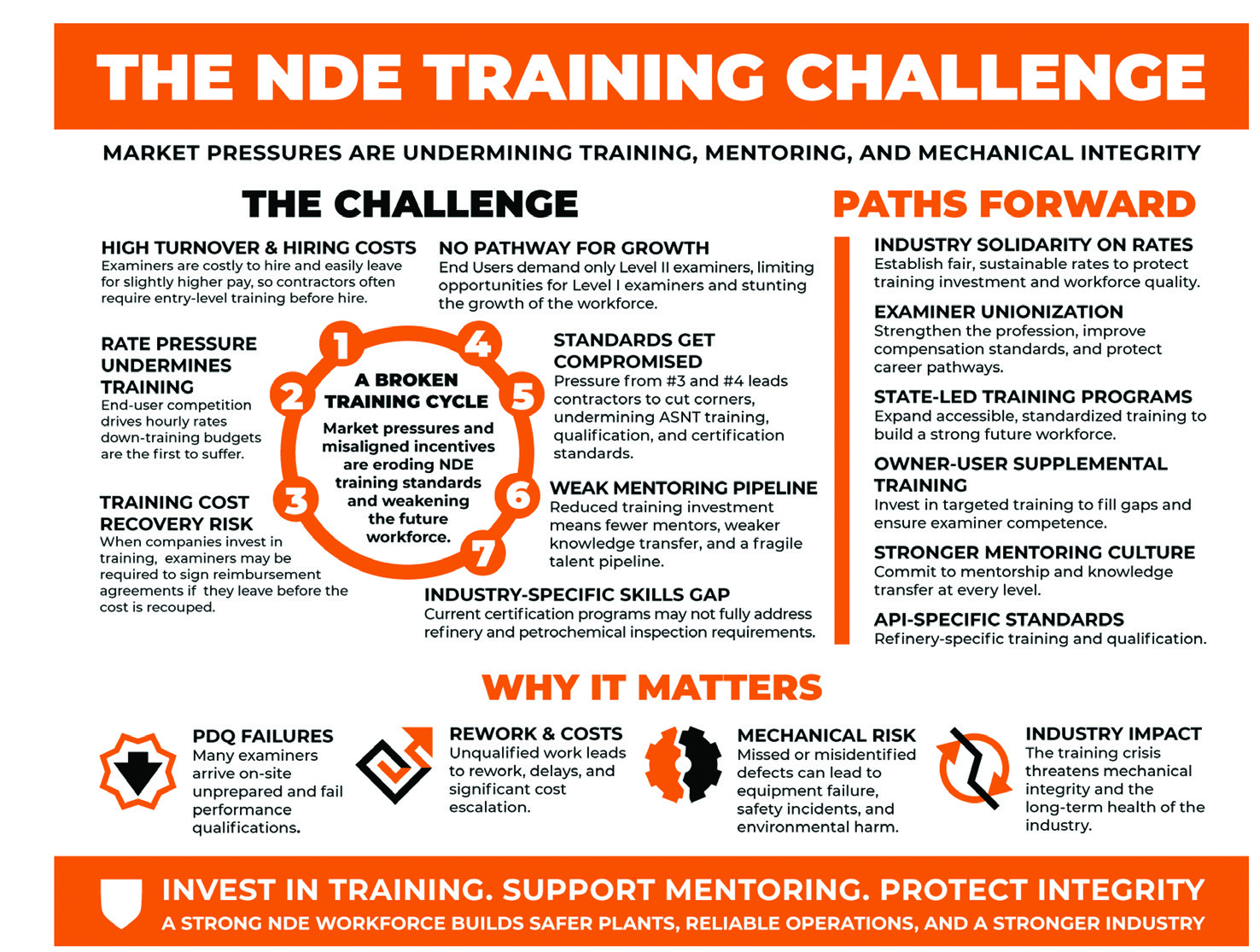
Implementing any of these solutions requires leadership from both owner-users and service providers. The most successful efforts will combine clear expectations, shared financial responsibility, and measurable outcomes (e.g., PDQ first-pass rates, turnover metrics, inspection efficiency).
6. Adoption of API-Specific Supplemental NDE Standards
Owner-users, service providers, and professional associations should collaborate with the American Petroleum Institute to develop supplemental NDE training, qualification, and certification requirements tailored specifically to downstream refining and petrochemical applications. These standards would build directly on existing ASNT certifications by incorporating expanded practical experience hours, focused training on oil-and-gas damage mechanisms, and performance demonstrations that mirror actual operating conditions. Such targeted standards would raise the baseline competence of contract examiners industry-wide while remaining fully compatible with current certification frameworks.
A Call for Collaborative Leadership
The NDE training crisis is not insurmountable, but it will not resolve itself through market forces alone. Owner-users who rely on contractor data for critical integrity decisions have both the leverage and the economic incentive to drive change. Service providers who invest in their people despite short-term margin pressure will differentiate themselves and retain talent in a competitive labor market.
By treating workforce development as a shared strategic priority rather than a cost to be minimized, we can rebuild a robust NDE talent pipeline. The result will be more reliable inspection data, higher-quality recommendations, fewer surprises during turnarounds, and ultimately safer, more reliable downstream assets.
The mechanical integrity community has a long history of solving complex technical problems through collaboration. Addressing the human side of the equation is no different. The time to act is now before the talent gap widens further and the cost of inaction becomes unacceptable.
REFERENCES
- Nanda, A., Challapally, A., Pease, C., Raskar, R., and Chari, P., 2025, The GenAI Divide: State of AI in Business 2025, Massachusetts Institute of Technology (MIT) Project NANDA, July 2025.
- Materials Technology Institute, 2025, “MTI Highlights the Value of the New AI Tool Through User Feedback,” MTI Connect, Vol. 13, No. 3, pp. 14–15, 2025.
Partner with Dynamis for an innovative and effective AIM program tailored to your success.
- Minimize wear and tear with predictive maintenance strategies to extend asset life
- Reduce risk exposure for personnel and the environment to enhance safety
- Decrease unplanned downtime and maximize asset availability to optimize costs
- Meet and exceed international standards such as API, ASME, and ISO to achieve compliance
CLIENTS + STRATEGIC PARTNERSHIPS


.png)
.jpg)